

The logistics lesson hiding inside Africa's most organized agricultural sector.
The Numbers That Should Concern You
Kenya exported 652 million kilograms of tea in 2025 — making it one of the largest tea exporters on the planet. The sector earned $1.44 billion in export revenue. The Mombasa auction has run for decades. Buyer networks span 100 countries. Grading is standardized. Documentation is mature.
And yet, as of this writing, 8 million kilograms of tea sit stranded in Mombasa warehouses — with losses accumulating at $8 million per week.
The disruption isn't caused by a production failure. Kenyan farms are still picking leaves. Factories are still processing. The tea exists.
It just can't move.

What Happened
The trigger is geopolitical: the closure of the Strait of Hormuz and the Port of Salalah following the Iran conflict has paralyzed shipping routes that connect Mombasa to its largest markets.
The Middle East — Pakistan, UAE, Egypt — accounts for 20-25% of Kenya's tea exports. Those routes are now either closed or rerouted around the Cape of Good Hope, adding weeks of transit time and compressing margins that were already thin.
Here's what George Omuga, managing director of the East Africa Tea Traders Association, told Reuters:
"The current conflict in the Middle East has had a direct impact, a negative impact on this auction."
Tea destined for Pakistan and Egypt is still technically moving — but via longer routes that drive up freight and insurance costs. Tea destined for direct Middle Eastern markets isn't moving at all.
The Kenyan government issued reassuring statements. Omuga's response was blunt: "Government's statements are just to give people comfort. The reality on the ground does not show a positive outlook."
Why Tea Matters as a Benchmark
Here's why this matters beyond tea.
Tea is arguably Africa's most organized agricultural export sector. It has:
- Decades of export infrastructure — the Mombasa auction has operated since the 1950s
- Standardized grading — buyers know exactly what they're purchasing
- Mature buyer networks — relationships spanning Pakistan, UK, Egypt, Russia, UAE
- Consistent quality — factory processing ensures uniformity
- Government support — the Kenya Tea Board, KTDA, and export promotion agencies
If any African agricultural sector should be resilient to logistics shocks, it's tea.
And yet: $23 million worth of product stranded. Exporters forced to air-freight tea to the UK at $2 per kilogram — eight times the normal sea freight rate of $0.25 — just to avoid being labeled "unreliable suppliers" and losing contracts entirely.
The lesson is uncomfortable: even the most mature export sectors are vulnerable when logistics systems tighten.
The Real Bottleneck
African export conversations focus too heavily on production.
Investors ask about yields. Development programs measure hectares planted. Trade delegations tour farms.
But exporters know the real questions:
- Can you get a container?
- Can you get it to port on time?
- Will the vessel actually arrive?
- Will customs clear before your buyer's deadline?
- Will payment flow back without friction?
These are not secondary concerns. They are the concerns.
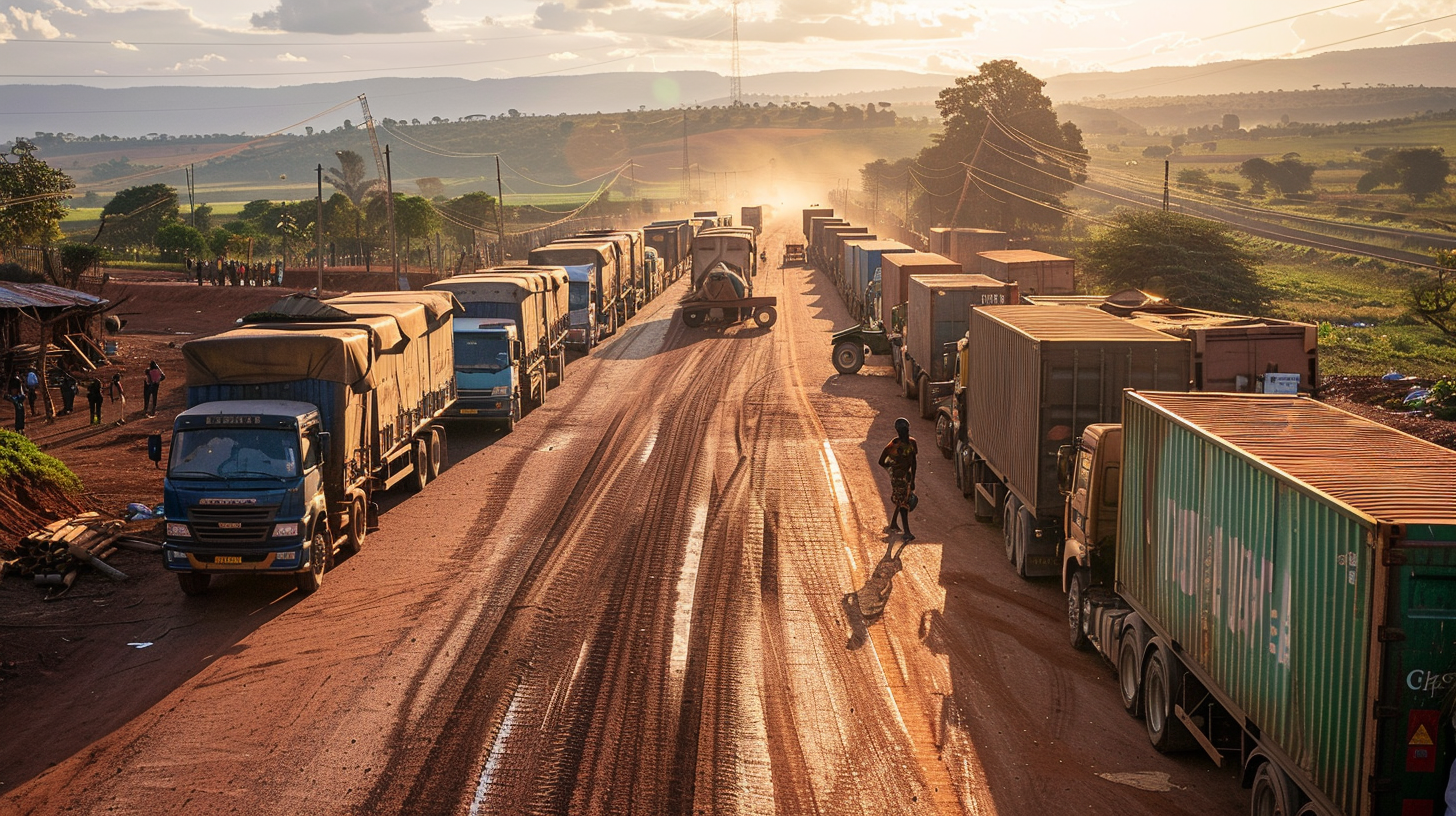
The tea disruption makes this visible because the production side is fine. Kenyan farmers are harvesting. Factories are processing. The problem is entirely downstream — shipping routes, port access, vessel availability.
For tea, this creates a crisis. For less organized sectors, it would create a collapse.
What This Means for Superfood Exporters
Now consider what happens when logistics tighten for sectors that don't have tea's infrastructure.
Honey — no standardized auction, fragmented producers, limited warehousing, buyers who expect consistent supply but have no mechanism to absorb delays.
Hibiscus — seasonal harvest windows, quality degradation if stored too long, buyers in Germany and the US who will simply source from Egypt or Mexico if you miss a shipment.
Moringa — powder that absorbs moisture, shelf-life concerns, buyers who need consistent color and mesh size or they reject the shipment.
Baobab — early-stage export sector, minimal aggregation infrastructure, buyers still testing African supply chains for reliability.
If Kenya's tea sector — with 70 years of export experience — loses $8 million per week when shipping routes close, what happens to a moringa exporter in DRC when the same disruption hits?
They don't have buffer stock. They don't have alternative routes mapped. They don't have buyers who will wait.
They simply lose the contract.

The Real Export Skill
The most successful African exporters are not just farmers. They are not even primarily farmers.
They are:
- Logistics managers — tracking vessel schedules, container availability, port congestion
- Documentation specialists — ensuring phytosanitary certificates, certificates of origin, and quality reports are ready before cargo arrives at port
- Buyer relationship managers — communicating delays early, negotiating flexibility, maintaining trust through disruptions
- Working capital strategists — financing the gap between shipment and payment, often 60-90 days
The tea exporters who air-freighted product to the UK at eight times the normal cost weren't doing it because air freight makes economic sense. They were doing it because losing a buyer relationship costs more than one expensive shipment.
That calculation — protect the relationship even when the transaction loses money — is the export skill that separates operators from farmers.
The Wake-Up Call
Kenya's Export Promotion and Branding Agency CEO said it plainly: "The ongoing conflict in the Gulf region, which has led to the closure of key maritime routes, is a wake-up call for Kenya to invest more in intra-Africa trade."
She's right about the wake-up call. But the lesson extends beyond market diversification.
The lesson is: export success depends on logistics reliability more than production capacity.
You can grow excellent tea, harvest it on time, process it to standard, and still lose $8 million per week because a port 5,000 kilometers away closes.
You can produce high-quality moringa powder, jar it beautifully, and still lose your US buyer because no vessel called at Mombasa during your shipment window.
You can aggregate honey from 50 cooperatives, test it for purity, and still watch it ferment in a warehouse because customs took three weeks instead of three days.
Production is necessary. Production is not sufficient.
The Lubembo Lens
At Lubembo Intelligence, we increasingly study export sectors not by what they produce, but by how reliably their goods move from rural production zones to international markets.
The tea disruption is a case study in a pattern we see repeatedly:
- Investors overweight production potential
- Operators underestimate logistics fragility
- Buyers expect reliability that supply chains cannot guarantee
We track these dynamics across honey, hibiscus, moringa, and baobab — not because we think superfoods will avoid the problems tea faces, but because we know they'll face worse versions of the same problems with less infrastructure to absorb the shocks.
The Takeaway
Africa does not lack exportable crops.
It lacks logistics systems that move them consistently.
The tea sector — with its auctions, its grading standards, its 70 years of buyer relationships — just demonstrated that even the best-organized export infrastructure can be paralyzed by forces beyond its control.
For every investor evaluating an African agricultural opportunity: ask less about yields and more about the corridor.
For every exporter building a supply chain: your farm is the easy part. Your port access, your vessel schedule, your customs timing — that's where the deal lives or dies.
For every buyer sourcing from Africa: the question isn't whether your supplier can produce. The question is whether they can ship. And whether they've built enough buffer to survive when they can't.
The tea is sitting in Mombasa. The farmers are still waiting to be paid.
That's the export lesson no one teaches until it costs you $8 million per week.
Lubembo Intelligence tracks trade flows, logistics costs, and supply chain realities across African agricultural exports. Subscribe for analysis on what's actually moving — and what isn't.


