

In agricultural exports, demand structures supply — not the other way around.
The Common Misconception
Conversations about African agriculture almost always start with land.
Where do crops grow? Which regions have the best soil? What's the rainfall pattern? How many hectares are under cultivation?
These are reasonable questions. But for anyone actually operating in export markets, they're often the wrong starting point.
The more critical question is: Who is buying, and what do they require?
Because in global agricultural trade, the buyer's specification doesn't just influence the supply chain. It determines the supply chain.
The same crop, grown in the same region, can require completely different handling, processing, packaging, and logistics depending on who the end buyer is.
Farm location matters. But buyer requirements matter more.
How Buyers Shape Supply Chains
Consider a simple comparison.
A local market buyer purchasing honey in Kinshasa accepts what's available. Raw honey, minimal filtration, whatever container the seller has. The transaction is simple. The requirements are low, so is the volume quantity thus buying less with no consistency.
Now consider a European food manufacturer sourcing honey for a product line. Their requirements might include:
- Moisture content below 18%
- Filtration to remove wax and debris
- Testing for pesticide residues and heavy metals
- Certificates of origin and phytosanitary documentation
- Food-grade packaging with specific labeling
- Traceability from hive to container
The honey itself might be identical at the farm gate. But the supply chain required to serve each buyer is completely different.
For the local buyer, the supply chain is simple: harvest, jar, sell.
For the European manufacturer, the supply chain requires: harvest, filter, test, certify, package, document, ship, clear customs.
The buyer's requirements create the operational structure. An exporter who doesn't understand this will build the wrong supply chain — and fail to close deals they should be winning.
The Specification Problem
Here's where many African exporters get stuck.
They focus on production first. They secure supply. They aggregate volume. They find product.
Then they go looking for buyers.
But buyers don't adapt to whatever supply is available. Buyers have specifications. And those specifications are non-negotiable.
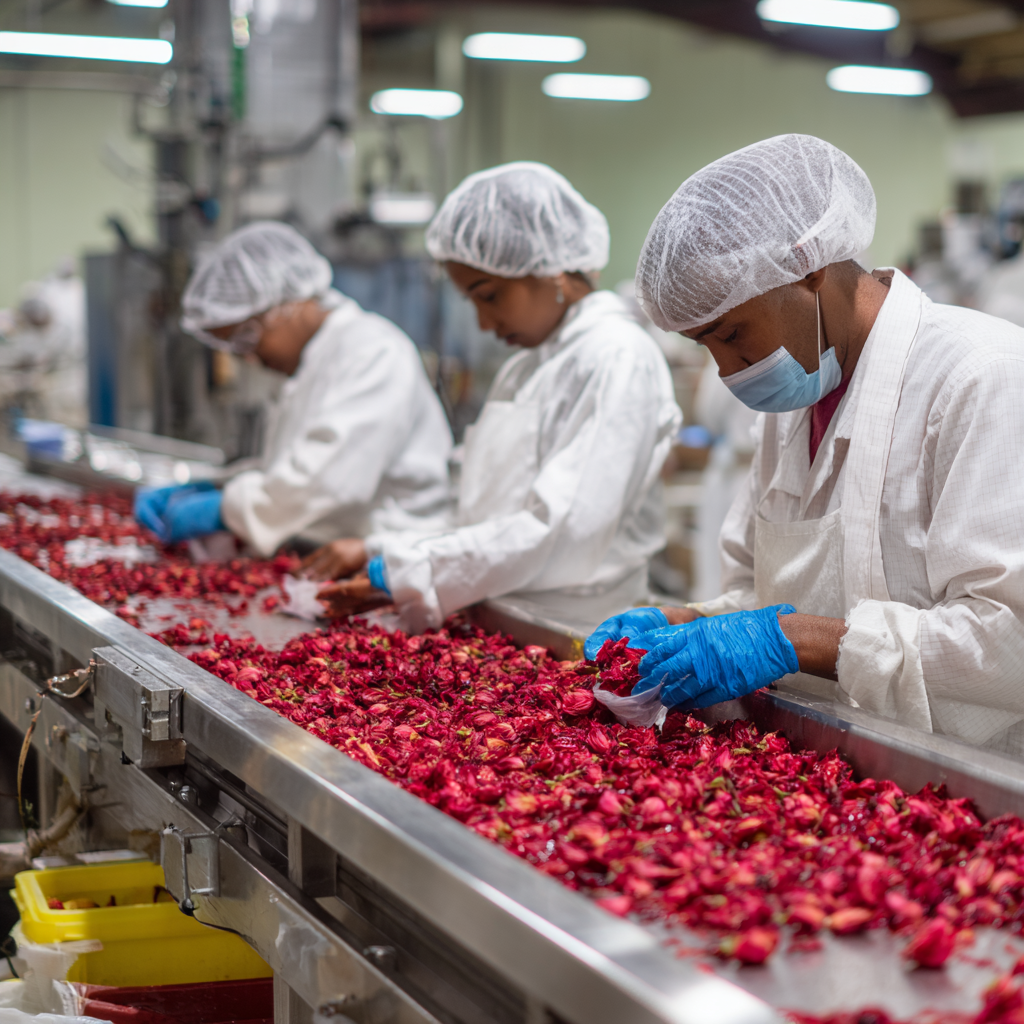
A German tea company sourcing hibiscus needs a specific color profile — deep red, not faded pink. That color depends on drying speed and temperature. If the hibiscus was sun-dried slowly in open air, the color degraded. The product doesn't meet spec. The buyer passes.
A US supplement brand sourcing moringa powder needs a specific mesh size and chlorophyll content. If the leaves weren't processed within hours of harvest, oxidation occurred. The powder is brownish instead of vibrant green. Doesn't meet spec. Buyer passes.
A UK honey importer needs moisture below 18% with documentation proving it. If the exporter can't test moisture or doesn't have the certificate, the shipment gets rejected at port.
In each case, the exporter had product. They had volume. They had supply.
What they didn't have was alignment with buyer requirements.

Examples Across Superfood Supply Chains
This pattern repeats across every botanical category we track.
Honey
Local markets accept raw, unfiltered honey. Export markets require moisture control (typically below 18-20%), filtration, and often third-party (ISO) lab testing. Some buyers require organic certification. Others require specific floral origin documentation. The buyer's position in the market determines which standards apply.
Hibiscus
Domestic buyers purchase dried hibiscus flowers for local beverages. Export buyers — particularly beverage brands and tea companies — require specific drying protocols, color consistency, and contamination testing. A kombucha brand in California has different requirements than a tea blender in Germany. Same crop, different specs, different supply chains.
Moringa
Local consumption often involves fresh leaves or simple sun-dried powder. Export markets for supplements and food ingredients require controlled drying temperatures, specific particle sizes (often 80-mesh or finer), and microbiological testing. The processing requirements for export-grade moringa are significantly more demanding than local market standards.
Baobab
Baobab fruit is consumed locally with minimal processing. Export markets for food ingredients and cosmetics require pulp extraction, standardization of vitamin C content, and compliance with food safety regulations in destination countries. The processing infrastructure required for export is entirely different from local consumption patterns.
Ginger
Fresh ginger moves easily in local markets. Export markets — particularly for dried ginger or ginger powder — require specific moisture levels, cleaning protocols, and often organic certification. The buyer's end use (food service, retail, industrial) determines which specifications apply.
In every case, the buyer's requirements dictate the supply chain structure. Exporters who understand this build backwards from the buyer. Exporters who don't understand it build forward from the farm — and struggle to close deals.

Why This Matters for Exporters
The strategic implication is significant.
Many new exporters invest heavily in production and aggregation before they've secured a buyer relationship. They build supply chains based on assumptions about what the market wants.
Then they discover that their product doesn't meet spec. Or their packaging is wrong. Or their documentation is incomplete. Or their processing isn't adequate.
Successful exporters often work in reverse.
They identify a buyer first. They understand the buyer's requirements. Then they build a supply chain designed to meet those specifications.
This doesn't mean ignoring production. It means organizing production around demand rather than hoping demand materializes for whatever you produce.
The most effective African exporters we've observed operate this way:
- Identify buyer requirements — What specs? What certifications? What documentation? What packaging?
- Assess supply chain gaps — Can we meet these requirements? What processing is needed? What's missing?
- Build backwards — Organize production, aggregation, and processing to deliver exactly what the buyer needs.
This approach doesn't guarantee success. But it avoids the common failure mode of building supply without understanding demand.
The Trade System Implication
This insight extends beyond individual exporters to the structure of African trade systems.
Building competitive agricultural export sectors requires more than increasing production. It requires understanding what international buyers actually need — and organizing supply chains to deliver it.
This means investing in:
- Processing infrastructure that can meet export specifications
- Testing and certification systems that buyers trust
- Logistics pathways that move products reliably
- Documentation capacity that satisfies import requirements
These investments don't start with the farm. They start with the buyer.
Countries and regions that understand this — that build infrastructure around buyer requirements rather than production volumes — will capture a disproportionate share of export value.
The Takeaway
In global agricultural trade, the most valuable asset is not simply land or production capacity.
It is the ability to understand buyer requirements and organize supply chains that meet them.
The farm matters. The region matters. The crop matters.
But the buyer matters more.
Understanding the buyer is not the final step in building an export business. It's the first step.
Everything else — production, processing, logistics, documentation — flows from that understanding.
The exporters who succeed are not necessarily those with the best farms. They're the ones who know exactly what their buyers need — and build everything around delivering it.
Lubembo Intelligence tracks how buyer requirements shape agricultural supply chains across Africa — from production zones to export markets. Subscribe for trade analysis on honey, hibiscus, moringa, baobab, and emerging botanical exports.


