

The policy sounds transformational. The corridor math — and a century of financing history — tell a different story.
In March 2026, Kenya officially rolled out the EAC Customs Bond — a unified guarantee system that lets traders move goods across East African borders with a single bond instead of multiple national deposits.
The headlines wrote themselves: "Game changer for regional trade." "Unlocking $2 billion in trapped capital." "Seamless movement across Partner States."
Lubembo operates as an aggregrator matching African superfoods suppliers to foreign buyers. Within the African continent, our sister company Micha Express (LINK) a logistics company moving goods from Kenya into Kinshasa, Democratic Republic of Congo (DRC). We've run the numbers with forwarders on the ground — from Nairobi, Johannesburg, and the Namibia-Angola corridor. For traders moving goods into DRC, this bond changes almost nothing.
The reasons go deeper than policy. They go back a century.
What the Bond Actually Does
The concept is simple and, on paper, elegant.
Previously, a trader moving cargo from Mombasa through Uganda to Rwanda needed separate customs bonds at each border — cash or guarantees tied up at every crossing, released only after goods cleared. For a single shipment, capital might be locked in three different jurisdictions simultaneously.
The EACBond consolidates this. One guarantee, recognized across all Partner States, covering the entire journey.
For landlocked countries dependent on Mombasa — Uganda, Rwanda, South Sudan — this is genuinely significant. Capital that was trapped at borders can now flow.
But here's the part the policy announcements don't mention: not every corridor benefits equally. And for DRC-bound trade, the fundamentals haven't changed.
The Real Numbers: Three Routes to Kinshasa
We spoke with forwarders running all three major corridors into DRC. The cost structures tell a story that policy frameworks don't capture.
Route 1: Kenya → DRC by Road
| Cost Component | Amount |
|---|---|
| Shipping line fees | $300 |
| Port charges (KPA) | $300 |
| Container deposit | $150 |
| Forwarder fee | $150 |
| Buffer for inconsistencies | $50-100 |
| Trucking (Kenya → Matadi) | $4,500 |
| Subtotal (Kenya side) | ~$5,500 |
Timeline: 4-5 days minimum, through roads described as "terrible." Multiple borders mean multiple inspections, tolls, and informal payments.
Then goods hit Matadi — and customs clears at roughly $17,000 per container.
Route 2: South Africa (SA) → DRC by Sea
| Cost Component | Amount |
|---|---|
| Shipping (SA → Matadi) | $6,000-7,000 |
| Customs fees at Matadi | ~$17,000 |
| Total | ~$23,000-24,000 |
Timeline: Approximately one week. Predictable, containerized, less handling risk.
Route 3: South Africa (SA) → DRC by Road (via Namibia/Angola)
| Cost Component | Amount |
|---|---|
| Transport | $13,000 |
| Parking | $170 |
| Road Fare | $2,850 |
| Bonds & Documents (SA) | Client pays |
| Bonds & Documents (Namibia) | Client pays |
| Bonds & Documents (Angola) | Client pays |
| Subtotal (before bonds) | ~$16,000+ |
Timeline: 2-3 weeks. Option to offload at Lufu border or continue to Kinshasa with all additional charges on client.
This route bypasses Matadi entirely — entering DRC through the Angola border at Lufu. But it requires separate bonds and documentation for three countries, and transport costs alone exceed $13,000.
The forwarder noted they've changed procedures due to fuel price volatility: "to avoid losing their profit."
The Pattern
Three routes. Three different cost structures. One common thread: moving goods into DRC is expensive regardless of origin.
| Route | Transport | Port/Customs | Total | Timeline |
|---|---|---|---|---|
| Kenya (road) | ~$5,500 | +$17k Matadi | ~$22,500 | 4-5 days |
| SA (sea) | $6-7k | +$17k Matadi | ~$24,000 | ~1 week |
| SA (road via Lufu) | ~$16k+ | Bypasses Matadi | ~$16,000+ | 2-3 weeks |
The Lufu corridor looks cheapest on paper — but 2-3 weeks of transit, three sets of bonds, and fuel volatility exposure create their own costs.
And here's what's striking: the EACBond addresses none of this. The Kenya route runs through EAC territory, but DRC isn't integrated into the bond system yet. The South Africa routes run through SADC — an entirely different customs framework.
Why Belgium Still Wins
Importers in Kinshasa have done this math. Many conclude it's cheaper to ship from Belgium than from anywhere in Africa.
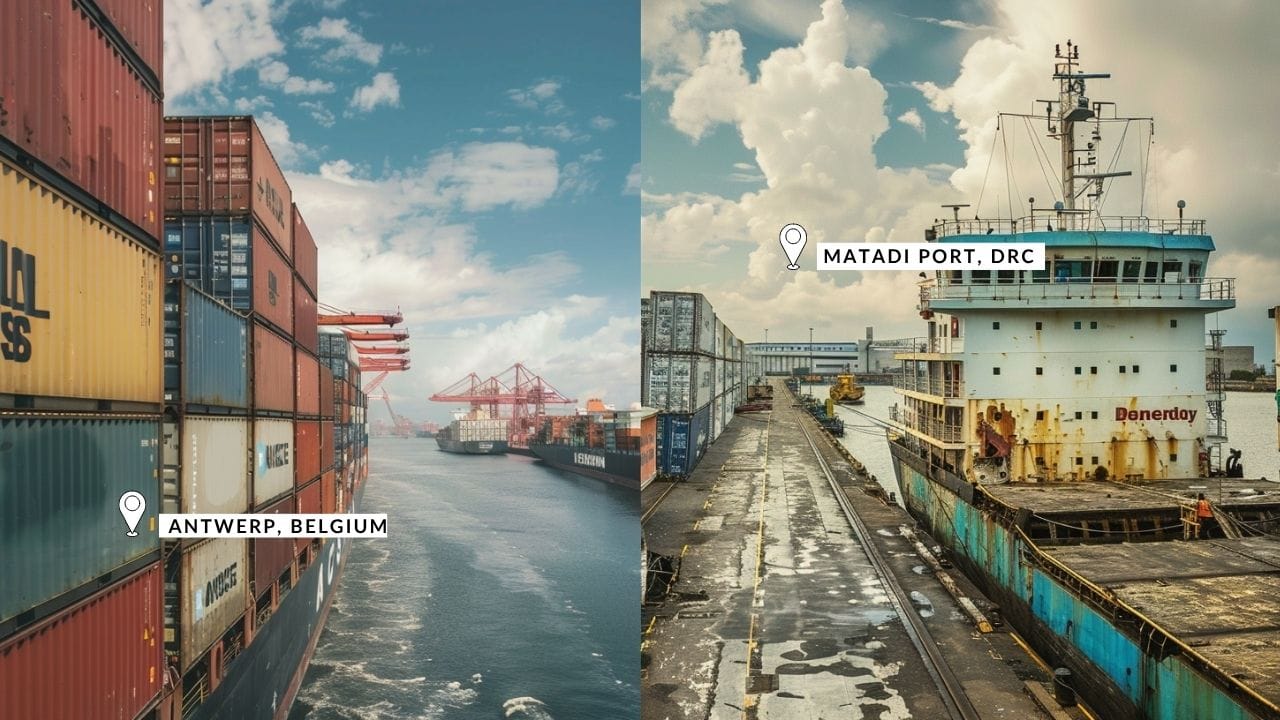
The obvious explanation is route optimization. Antwerp → Matadi has been a functioning corridor for over a century. The infrastructure exists. The shipping lines are established. Transit times are predictable.
But the deeper reason is one that rarely gets discussed: financing.
European shipping routes aren't just physically established — they're financially established. Belgian banks, insurers, and shipping lines have century-old credit relationships on the Matadi corridor. A European supplier can offer 60-90 day payment terms backed by trade finance facilities refined over generations.
An African supplier? Cash upfront. Or expensive letters of credit that eat into already thin margins.
This is the colonial inheritance that still shapes trade flows. Whoever financed the original maritime routes retains structural control over supply and demand. African cross-border trade isn't just competing against geography — it's competing against a century of accumulated financial infrastructure that routes value extraction outward, not inward.
The EACBond does nothing to address this. Neither does AfCFTA in its current form. As Afreximbank's chief economist recently noted, trade finance remains "a critical transmission channel" that Africa has yet to build at scale.
The DRC Problem
The Democratic Republic of Congo joined the East African Community in 2022. On paper, it's a Partner State with access to all the benefits of regional integration.
In practice, it's more complicated.
A member of our supply network at Lubembo Aggregrator, recently attempted to use a Congolese passport to apply for a Kenyan business visa, expecting the EAC-member discount. The lawyer's response was blunt: "Congo is recognized as part of EAC, but it's not legislated. You're treated the same as any other foreign national."
The customs bond follows the same pattern. The pilot phase includes Uganda, Kenya, and Rwanda. Tanzania is coming. DRC? Somewhere in the future rollout — timeline unclear.
Until DRC's integration is legislated and operationalized, traders moving goods into DRC don't benefit from the new framework.
The Geography Lock
Even if DRC were fully integrated tomorrow, there's a structural issue: the Mombasa-to-Kinshasa route doesn't make geographic sense.
Mombasa sits on Kenya's eastern coast. Kinshasa sits on DRC's western edge. Between them: the entire width of the African continent.
By sea, Mombasa → Matadi requires sailing around the Cape of Good Hope. Our forwarder contact was direct: "You can't really do by sea. If you look at the map, Kenya is all the way east — you'd have to pass by South Africa."
The overland alternatives exist — but as the route data shows, they come with their own costs, timelines, and bond requirements.
This isn't a failure of the EAC bond system. It's geography. No policy instrument changes the fact that Kinshasa faces west while Mombasa faces east.
The $230 Billion Question
The African Continental Free Trade Area promises to reshape these dynamics. Intra-African trade is projected to hit $230 billion in 2026, up 10% from 2025. Manufacturing and agri-food sectors are expected to account for nearly half of intra-African trade flows.
But the gap between aspiration and execution remains vast. Africa's share of global exports sits at roughly 3%. African exports are an estimated $433 billion below their potential.
The bottleneck isn't tariffs — AfCFTA is addressing those. The bottleneck is infrastructure, trade finance, and the accumulated advantages of routes optimized for extraction rather than integration.
Building intra-African trade corridors that can compete with colonial-era routes will take decades. The financing infrastructure alone — the banks, insurers, and credit facilities that make trade flow — requires patient capital and institutional trust that doesn't exist yet at scale.
The Air Cargo Escape Hatch
Here's what's actually happening on the Kenya-to-DRC corridor while everyone waits for policy to catch up: air freight is winning.
Through Micha Express (LINK) — our logistics operation moving goods from Nairobi and Kampala to Kinshasa — we see consistent demand for high-value, time-sensitive items: pharmaceuticals, medical supplies, vitamins, packaged foods.
The math: a container from Mombasa to Matadi takes weeks and costs a fortune in fees, tolls, and delays. Air cargo from Nairobi to Kinshasa takes hours. For goods with margin to absorb the freight premium, air wins.
This pattern reveals something important about where African trade can leapfrog rather than catch up.
What This Means for Superfoods
For traders in our space — honey, moringa, hibiscus, baobab — the implications are significant.
Africa has the climate and land to dominate global superfood production. But superfoods aren't staple foods here — local consumption is minimal compared to Western and Gulf markets. This creates unique positioning: 100% export-oriented products that don't compete with domestic food security priorities.
More importantly, superfoods have characteristics that let them bypass the infrastructure problem:
High value-to-weight ratio. A kilogram of moringa powder or premium honey can absorb air freight costs that would destroy margins on bulk commodities.
Lower volume thresholds. Meaningful trade can happen at 5-15 tonnes — not container-scale.
Premium positioning. Buyers pay for origin story, traceability, and quality — not just commodity specifications.
No colonial route dependency. Because superfoods weren't part of the extraction economy, there's no established European financing infrastructure to compete against.
While AfCFTA works to fix bulk commodity corridors — a project that will take decades — superfoods can move now.
The Bigger Picture
Regional integration in Africa is a slow, uneven process. The EACBond is a genuine step forward — for the corridors it was designed for.
But policy announcements often outpace operational reality. Traders on the ground know which routes actually work, which cost structures pencil, and which bonds need to be posted where.
The forwarder data tells the real story: three corridors into DRC, three different cost structures, zero integration between them. Kenya runs through EAC. South Africa runs through SADC. The Lufu corridor crosses both blocs plus Angola.
For DRC-focused traders, the practical takeaway: don't wait for regional integration to solve logistics challenges. Build supply chains around the routes that work today — and treat policy developments as potential future upside, not current strategy.
At Lubembo, we're watching both the EACBond rollout and AfCFTA implementation closely. When the corridor math actually changes, we'll report it. Until then, the numbers are what they are.
Lubembo Intelligence tracks trade policy, logistics costs, and supply chain realities across African markets. Subscribe for monthly updates on what's actually changing — and what isn't.


