

Origin Spotlight goes behind the supply chain — to the partnerships, the places, and the people that make African superfood trade possible. Quarterly.
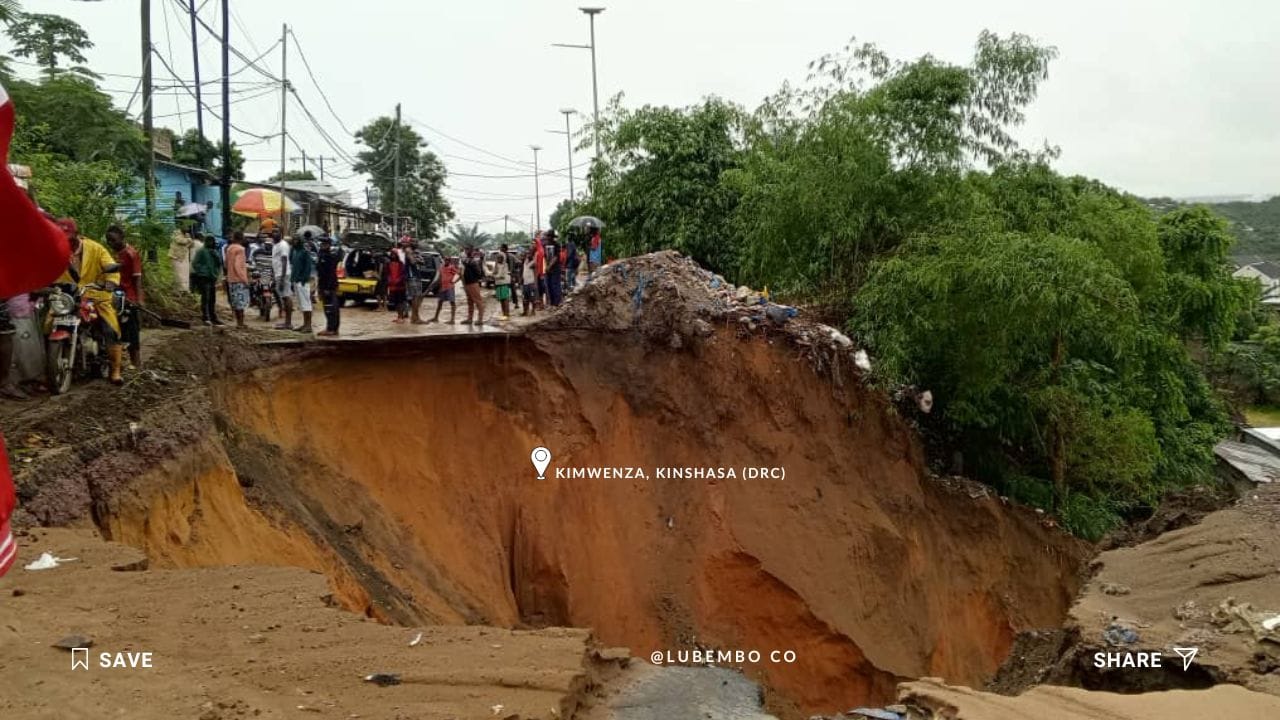
The day after we completed our site visit at Kimwenza, the road broke in half.
Not metaphorically. The road — one of the main arteries connecting the Kimwenza site to Kinshasa proper — physically split open due to erosion. A section of tarmac collapsed into the earth beneath it, and what had been a functioning route became impassable overnight.
We had been scheduled to begin formalizing the partnership the following week.
That road has since been repaired twice. It has broken again each time.
This is not a story about bad luck. It is a story about what African superfood supply chains are actually built on — and what they will need to reach their potential.
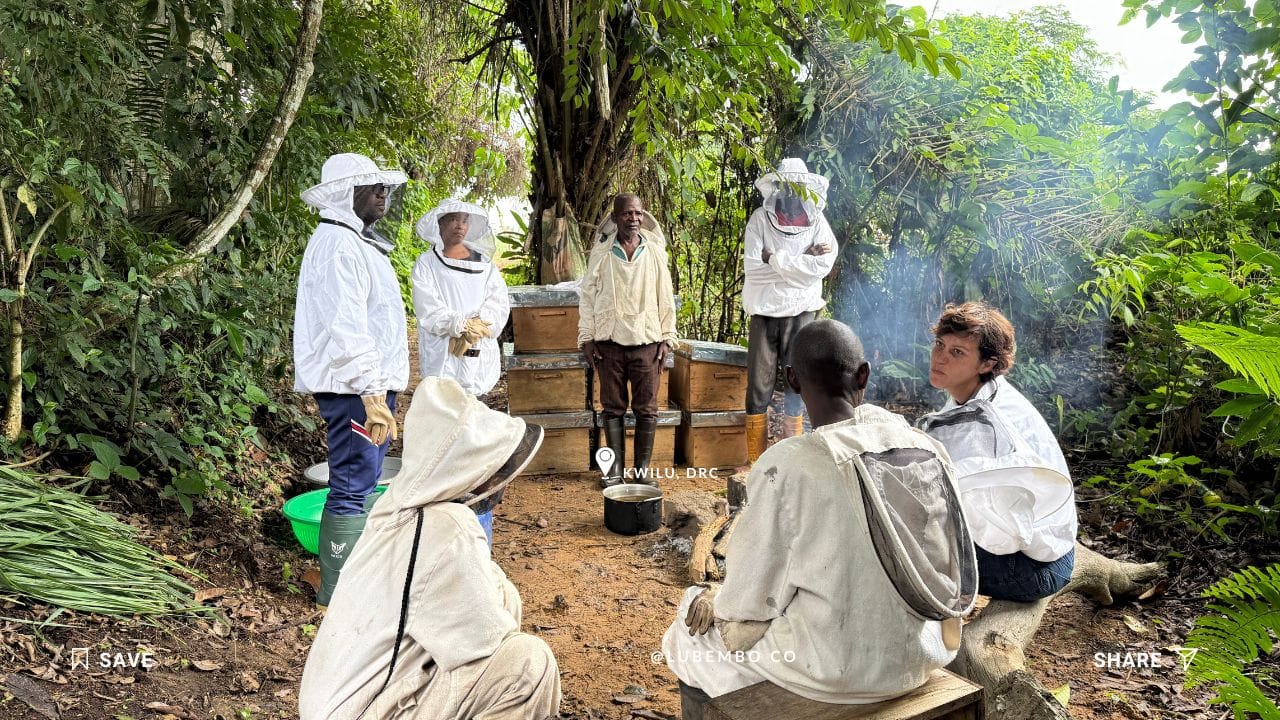
Who Les Amis de Bonobos (ABC) Are
Les Amis de Bonobos du Congo is one of the DRC's most established conservation NGOs. If you search them, you'll find their work protecting bonobos — a species of great ape found only in the Congo Basin, one of the most biodiverse ecosystems on earth — across the Équateur province, the vast equatorial forest that sits at the geographic centre of the country.
They also operate a site at Kimwenza, on the border of Kongo-Central and Kinshasa. This is where we first encountered the possibility of a partnership.
The conversation began when Fanny, one of the organisation's lead executives, reached out to Lubembo. The interest was practical: the traditional NGO funding model is under pressure globally, and organisations like Les Amis de Bonobos are increasingly looking for ways to generate additional income for the communities they serve — income that doesn't depend on donor cycles or development grants.
Their communities in Équateur already live inside one of the greatest forest honey ecosystems on the continent. The logic of turning that proximity into a livelihood was obvious once someone said it out loud.
What wasn't obvious was how to do it commercially.
Why Équateur's Honey Matters
The Équateur province is not a name that appears in most honey market reports. It should.
The Congo Basin forest that covers much of Équateur is one of the world's last largely intact tropical forest ecosystems. The biodiversity of its flowering species — the variety of nectar sources available to bees across seasons — produces honey with a flavour complexity and a wild, unprocessed character that is genuinely distinctive in a global market where most honey is industrial, blended, and stripped of regional identity.
When we talk about Congo Basin forest honey at Lubembo, Équateur is at the heart of what that means. The same forest that shelters bonobos and contains species that exist nowhere else on earth is the foraging territory of the bees whose honey we are trying to bring to export markets.
This is not a marketing construction. It is a biological fact with commercial implications. The distinctiveness of the honey is a direct function of the distinctiveness of the ecosystem. Protecting one is, in a very literal sense, protecting the other.
The communities who live in and around that forest are not obstacles to conservation. They are the people whose economic incentives determine whether the forest stands or falls. Give them a commercial reason to protect what surrounds them and you have aligned conservation logic with livelihood logic in a way that no amount of donor-funded awareness campaigns can replicate.
This is what Les Amis de Bonobos understood when they reached out. And it is why the partnership made sense before a single hive was installed.
The Road That Broke
Kimwenza was the starting point because it is accessible — or was. The site sits at the border of Kongo-Central and Kinshasa, reachable from the capital without the extreme logistics challenges that characterise reaching the Équateur interior. Our initial site visit confirmed it qualified for honey production. The environment was right. The community was engaged. The training protocols we had developed on our Bandundu farm translated.
The morning after we completed the visit, the road collapsed.
What that meant practically: the Kimwenza site cannot function as a commercial honey production and aggregation point if the primary access route is unreliable. Lubembo's aggregator model requires roads. Not perfect roads — this is Congo — but roads that hold. A production site that produces honey which cannot be moved is not a production site. It is an inventory problem.
The erosion issue at Kimwenza is not an isolated incident. The DRC sits on extraordinary water resources, and the same geology that makes the country one of the world's most important hydropower opportunities makes its roads vulnerable to exactly this kind of failure. The road has been patched twice since the initial collapse. It has failed again each time. The underlying condition has not been treated because treating it requires a level of engineering investment that no municipal budget has allocated.
We are now in discussions about whether the Équateur site — the original forest, the deeper community, the better honey — can carry the commercial ambition that Kimwenza briefly made seem close.
The Équateur Problem
Équateur's honey is remarkable. Équateur's logistics are not.
Getting to Équateur from Kinshasa or Matadi requires either a small regional flight or a boat journey on the Congo River — the second-longest river in the world by discharge volume, and not a reliable commercial freight corridor for time-sensitive perishables. Either route involves delays, costs, and uncertainty that make scaling production commercially challenging in ways that have nothing to do with bees.
This is the tension at the heart of Congo honey: the best product comes from the hardest-to-reach places. The same forest isolation that makes the honey distinctive is the thing that makes it difficult to move.
We are working through what a viable logistics model looks like for Équateur production — whether aggregation at scale can happen closer to the production zone before a single consolidated movement to Kinshasa, and what infrastructure would need to exist for that to be reliable.
We do not have a clean answer yet. That is itself the honest thing to report.
Why Infrastructure Is the Real Investment Thesis
Something was said at a conference in Berlin last year — the kind of remark that gets noted and then filed — about the role of private capital in African infrastructure. The observation, attributed to figures from established European investment houses, was that the extraction of value from Africa's resource base is fundamentally constrained by the absence of infrastructure to move it, and that this constraint represents an investment opportunity as significant as the resources themselves.
The Kimwenza road is a small illustration of a large thesis.
For a long time, African infrastructure was understood as a government responsibility — and government delivery was, across most of the continent, unreliable. What is shifting now, visibly in DRC and across East Africa, is the recognition among private capital that if you want to extract minerals, move agricultural commodities, or build any kind of commercial supply chain, you cannot wait for government roads, government power, or government connectivity.
The success of Starlink across Africa is the cleanest recent example: private infrastructure, delivered at speed, solving a connectivity problem that government programmes had failed to address for decades. The Lobito Corridor — $6 billion in committed private and institutional capital to move minerals from DRC's Copperbelt to Angola's Atlantic port — is the largest-scale version of the same logic.
In Kenya, the entities that control power and logistics infrastructure carry private shareholders alongside government ownership. The line between public infrastructure and private investment is already blurring. In DRC, it is only beginning to blur — but the direction is clear.
Whoever controls the movement and transformation of goods in the Congo Basin will capture the value that its extraordinary natural resources generate. That requires roads. It requires energy. It requires cold chain and aggregation infrastructure. None of these will be delivered by government budgets alone. The private capital is beginning to understand this, and it is beginning to move.
The Kimwenza road breaking twice is not a curiosity. It is a data point in a much larger pattern.
What We Are Building Toward
Les Amis de Bonobos is the first external partner in what Lubembo is developing as an aggregator model for the DRC — and eventually beyond.
The model has a specific shape: identify organisations with established community relationships and access to productive forest land; provide training in commercial beekeeping protocols developed on our own farm; supply the production tools that kill most African producers before they reach commercial scale; and deploy a 20-foot container meadery — a mobile honey processing and extraction unit — that allows us to capture up to 40% of the value chain within the DRC before a single kilogram leaves the country.
The off-take arrangement is the commercial anchor: Lubembo commits to purchasing what the communities produce at agreed quality standards. The community has income. The NGO has a revenue model that complements its conservation mission. Lubembo has supply.
For buyers and investors reading this: the significance of a partner like Les Amis de Bonobos is not only logistical. An organisation that has spent years earning the trust of forest communities in Équateur brings a credibility to the supply chain that cannot be manufactured. When we say this honey comes from communities who protect the Congo Basin forest, the association with Les Amis de Bonobos is the evidence behind that claim, not the marketing language in front of it.
Traceability, in the end, is about trust. And trust in African supply chains is built through partnerships like this one — imperfect, specific, and documented honestly, including the road that broke in half and the logistics problem we have not yet solved.
Origin Spotlight is Lubembo Intel's quarterly series featuring the partnerships, places, and people behind African superfood supply chains.
Lubembo Intel | Ground Truth African Intelligence | lubembointel.com


