

A brand that truly deserves applauds and recognition is, Flamingo Estates, the California food and lifestyle brand, sells honey. It also sells beeswax candles, propolis tincture, flavored honey varieties infused with local botanicals, and a skincare line that uses wax and pollen as active ingredients. The honey is how most people find them. The honey is not where most of the margin lives.
Australian honey producers — among the most commercially sophisticated in the world given their proximity to New Zealand's Manuka premium market — have built operations around similar logic. Raw honey for export. Honey mead and tonic beverages for domestic premium retail. Beeswax for cosmetics and household products. Bee pollen for the supplement market. Lemongrass and native botanical-infused varieties for gift retail.
They are not doing this because they are environmentally principled. They are doing it because they did the unit economics and discovered something inconvenient: the highest-margin products from a beehive are not the honey.
In most of Africa, the wax is thrown away.
The Byproduct Map
Across all four of Lubembo's core superfoods — honey, baobab, moringa, and hibiscus — there is a consistent pattern. Primary product extracted. Everything else discarded or ignored. Export of the raw commodity. Margin captured downstream by processors, formulators, and brands in destination markets.
Here is what is being left on the ground.
Honey A standard honey harvest from movable-frame hives produces four primary outputs: honey, beeswax, propolis, and pollen. African beekeeping operations typically monetize one.
Beeswax as an income generating resource is neglected in some areas of the tropics. Worldwide, many honey hunters and beekeepers do not know that beeswax can be sold or used for locally made, high-value products. It is impossible to give statistics, but maybe only half of the world's production of beeswax comes on to the market, with the rest being thrown away.
Most people in Kenya throw away wax combs upon harvesting or after honey extraction. Beekeepers do not know its value.
The global propolis market was valued at approximately $610 million in 2020 and is growing at 5.48% annually. Propolis and honey bring high commercial value, with propolis increasingly demanded for its antimicrobial and anti-inflammatory properties in supplement, cosmetic, and pharmaceutical markets. In most African beekeeping contexts, propolis is scraped off the hive and dropped.
The mead market — fermented honey wine — is the product category that has made the most visible inroads into export positioning for African honey. Ethiopia has brewed Tej locally for generations. What it has not done is position that tradition as a premium export product in the way that Australian and US craft mead producers have.
Then there is the soap. Beeswax makes an excellent base for cosmetic products — lip balm, skin cream, furniture polish, leather conditioner. The DRC soap market is substantial. The same beeswax currently being thrown away by beekeepers in Bandundu and Équateur is an ingredient that a domestic processor could turn into a product already in high informal market demand.
Baobab
The baobab fruit, when cracked and processed, yields three distinct commercial streams: pulp powder (the primary export product), seeds (from which oil is pressed), and shells (from which biochar is made).
The international market for baobab oil is around 7 tonnes, while local trade of baobab oil in Southern Africa is around 11 tonnes. The low volumes suggest the baobab oil market is still underdeveloped. Baobab oil is cold-pressed from the seed kernel after the pulp is separated. It is rich in omega fatty acids, has a shelf life longer than most natural oils, and is increasingly demanded by European cosmetic brands reformulating around natural ingredients. In November 2023, Evonik Industries AG launched a sustainable product called ECOHANCE Soft Baobab oil, made from the non-edible seeds of the baobab fruit sourced from the Sahel region of Ghana, for use in hand creams, hair conditioners, and body butters.
The shells — the hard outer casing that most processors crack open and pile outside the facility — are already being converted to biochar at commercial scale in Zimbabwe. Outside the factory, the hard shells are turned into biochar, an ash given to farmers for free to make organic compost. That operation gives the biochar away. A more commercially structured version sells it — to regenerative agriculture operators, to carbon credit programmes, to domestic smallholder farms that would otherwise purchase synthetic fertiliser.
The harvester in Zimbabwe earns $0.17 per kilogram of baobab fruit. The branded product retails at 50 times that price. The shells that could generate a third revenue stream are currently given away.
Moringa
Moringa's primary commercial product is the dried leaf powder — high protein, high micronutrient, growing demand in nutraceutical and functional food markets globally.
The seed is almost universally discarded in African moringa operations. This is an error of significant commercial magnitude.
Moringa seed oil has a fatty acid composition comparable to olive oil. It has also been shown to be particularly effective in the manufacture of soap, producing a stable lather with high washing efficiency. The seed cake remaining after oil extraction — the pressed residue — contains active protein fractions that function as a natural water purification agent. Research has observed 90% turbidity removal by moringa seed extract in water samples. In communities without reliable clean water access, moringa seed cake is a low-cost, locally produced alternative to synthetic chemical coagulants. The same material used as agricultural fertiliser increases crop yields by 25–30%.
None of these applications require importing anything. They require pressing the seed rather than discarding it.
Hibiscus
Most hibiscus consumed as tea — whether called zobo in Nigeria, bissap in Senegal, or karkadé in Egypt — leaves behind a spent calyx that is thrown away. This is a missed stream in two directions.
First, the spent calyces retain significant anthocyanin content — the pigment compounds responsible for hibiscus's deep red colour. Natural food colouring from plant-derived anthocyanins is a growing ingredient category in the European food industry, driven by consumer and regulatory pressure away from synthetic dyes. The pigment in a spent hibiscus calyx, currently going into the bin, is a raw material that cosmetic and food manufacturers in destination markets are actively seeking.
Second, hibiscus seed oil — extracted from the seeds typically discarded during calyx processing — has documented use in skincare formulations. Residual cakes generated from producing oils from hibiscus seeds are rich in protein and can be used as raw material for additional food products. The full hibiscus plant — calyx, seed, stem — has commercial applications at every stage. Most African processors use one part.
The Palm Oil Worked Example
The DRC already contains a proof of concept for this logic that most operators walk past every day.
Red palm oil during dry season in Kinshasa: 25 litres costs approximately Fr.65,000 — around $29 USD at current rates. Kernel oil: 25 litres at Fr.120,000, roughly $53 USD. Data date: 24 July 2026, $1=2250Fc.
A single bar of soap in the informal economy — unpackaged — sells for Fc800 to Fc1,500. Packaged simply, Fc1,500 to Fc2,500. That is between $0.67 and $1.11 per bar. The transformation of palm oil into soap multiplies the value of the raw material by a factor that no export contract for raw palm oil can match.
The informal economy already knows this. Women across Kinshasa and Lubumbashi are running exactly this calculation at small scale every day, adding local botanicals — lemongrass, honey, moringa — to create products that sell at a premium in neighbourhood markets.
What they are doing manually, without processing equipment, without quality control, without packaging infrastructure, is the same logic that Flamingo Estates has built a premium lifestyle brand around. The difference is not the insight. The difference is the machine.
The Semi-Automated Argument
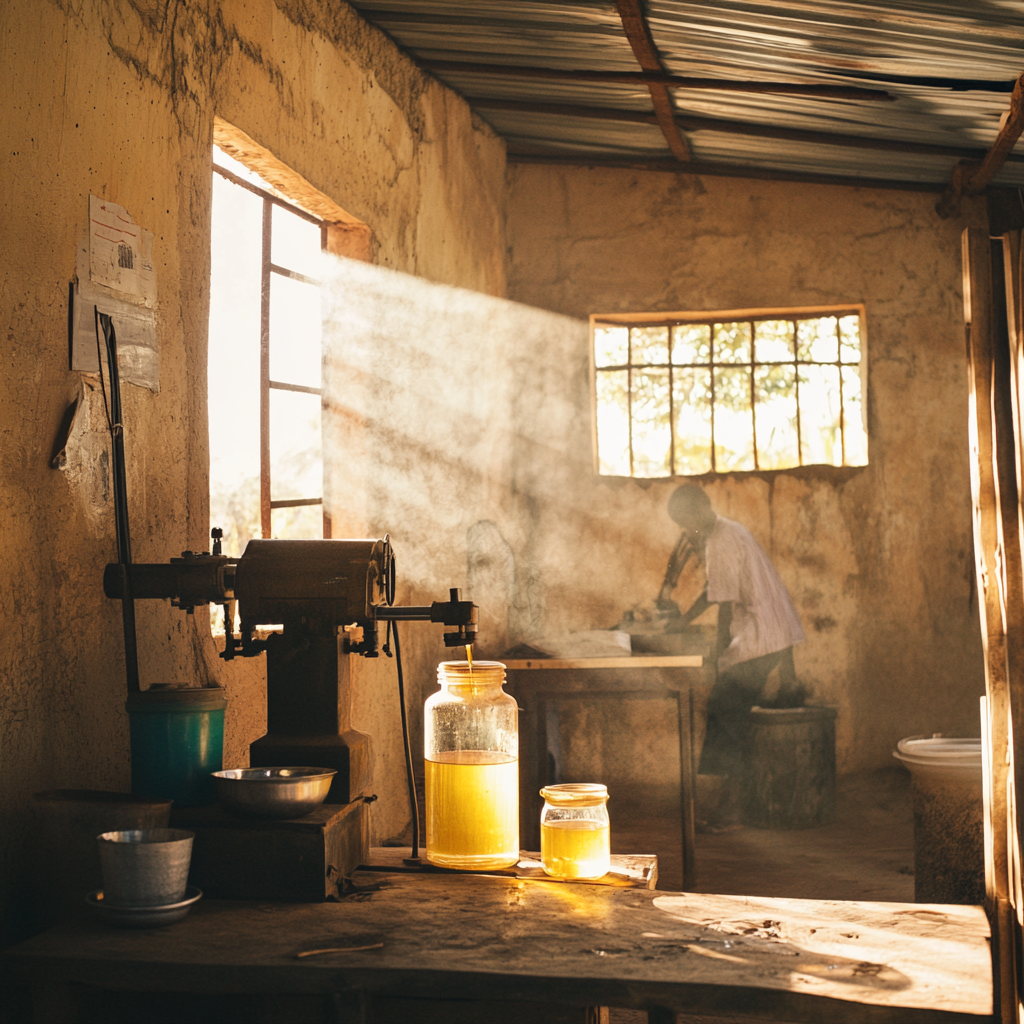
The missing piece in this conversation is not capital at industrial scale. A 50-kilogram cold-press oil expeller — the machine that turns baobab seeds or moringa seeds into oil — costs between $800 and $3,000 depending on specification. It can run on a generator or a solar inverter. It does not require a factory or a three-phase power connection.
A basic biochar kiln for processing baobab shells or other agricultural waste can be built locally for under $500. The Kenya appropriate technology sector — several Nairobi-based manufacturers — has developed exactly the kind of modular, semi-automated equipment the user described: small enough to fit in a 20-foot container deployment, energy-efficient enough to run on battery or diesel backup, specific enough to handle a single processing task without requiring industrial infrastructure around it.
The India parallel is instructive. Small-scale oil expellers, manual soap presses, village-level solar dryers — these are not compromises forced by poverty. They are the right scale for the supply chain at its current stage. A centralized industrial facility requires centralized raw material supply, centralized power, and centralized distribution — none of which exist in most DRC production zones. Distributed, semi-automated equipment deployed at aggregation nodes matches the actual structure of the supply chain rather than the imagined one.
The Investment Thesis in One Paragraph
The byproduct streams documented above are not environmental opportunities. They are margin opportunities. The same processing infrastructure that extracts baobab oil from seeds also creates a better-quality primary powder product, because the discipline required to separate and press the seed correctly imposes handling standards on the overall operation. The same beeswax management that enables candle and cosmetic production also improves honey quality, because wax separation is part of proper extraction protocol. Zero-waste processing and export-grade primary product quality are not separate goals. They are the same investment.
The machines exist. The markets exist. The raw material is abundant in the Congo Basin and across East and Central Africa.
What has not yet been assembled is the operator willing to deploy processing infrastructure at a scale appropriate to the supply chain — not a factory, not a cooperative grant, but a purpose-built semi-automated processing unit positioned at an aggregation node, running on local energy, turning every part of the harvest into something someone will pay for.
That is the gap. It is also the business.
Lubembo Intel publishes ground-level intelligence on African superfood supply chains. We source, we process, and we document what we learn.
lubembointel.com | hi@lubembo.co


